

One bunch, one glass
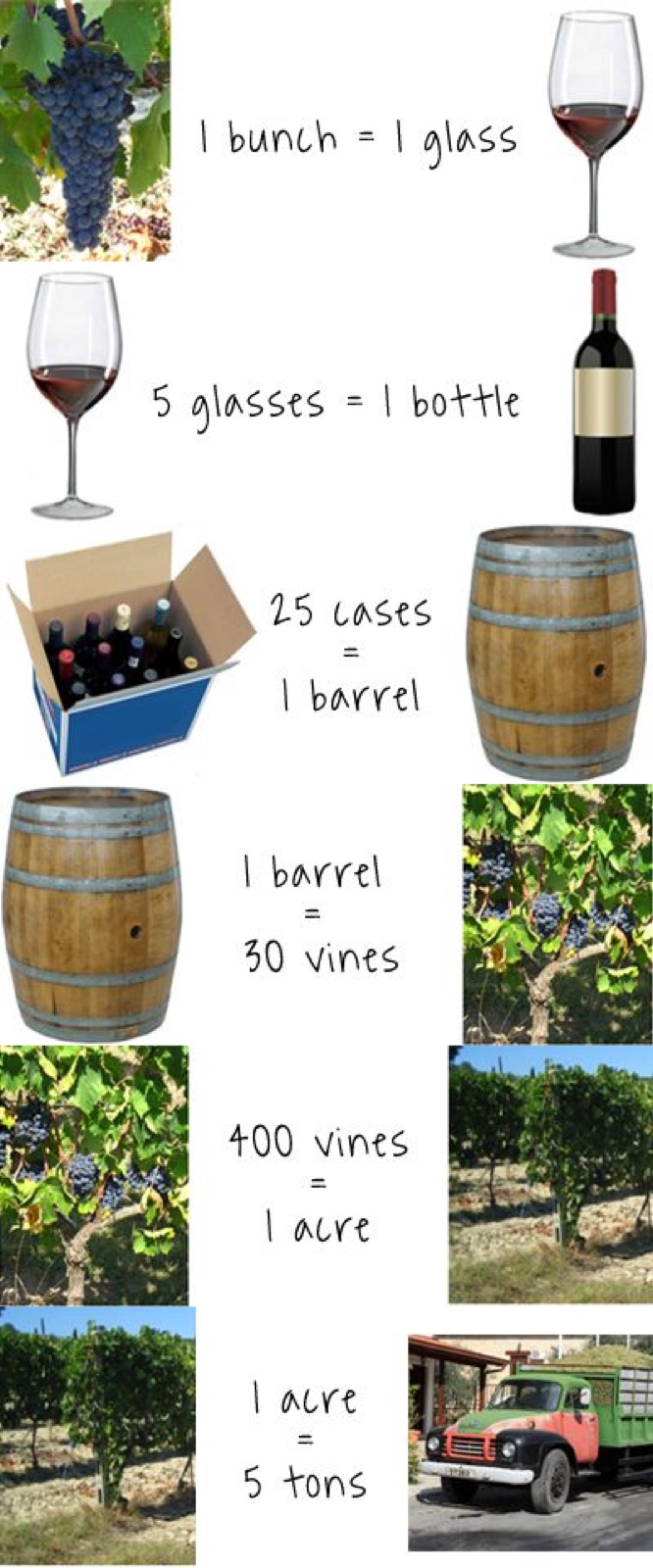
A single bunch of grapes fills one glass. Follow that chain up through bottles, barrels, vines and acres, and you can see exactly why the growers we pour make so little wine.
Every wine list is arithmetic before it is anything else. This chart has been passed around the trade for years, and it is still the plainest explanation we have found of why the growers we pour make so little wine — and why you have probably never seen their labels in a supermarket.
## Read it from the top
**One bunch, one glass.** The bunch you could hold in one hand, with a hundred-odd berries on it, is the glass in front of you. Not a bottle. A glass.
**Five glasses, one bottle.** A bottle holds 750ml and a proper pour is about 150ml, so five bunches have to come off the vine before anyone corks anything.
**Twenty-five cases, one barrel.** A barrique holds 225 litres — three hundred bottles, twenty-five dozen. That is one barrel in a cellar that might hold a dozen of them, and it is already fifteen hundred bunches of fruit.
**One barrel, thirty vines.** Thirty plants, a single row, to fill one barrel.
**Four hundred vines, one acre.** Thirteen barrels an acre, give or take.
**One acre, five tons.** Which is where the chart closes its own loop rather neatly: five tons of fruit yields somewhere around three thousand litres of wine, and thirteen barrels at 225 litres is about the same number. The arithmetic hangs together.
## What that means for a small grower
Work it backwards and the scale of these operations stops being abstract. A grower with three acres — a block you could walk across in a couple of minutes — is making in the region of forty barrels. Call it twelve thousand bottles in a good year.
Twelve thousand bottles sounds like a lot until you try to sell it. It is not enough to interest a supermarket chain, not enough to justify a distributor in another country, and nowhere near enough to fund a cellar door of your own, staffed seven days, on a road that most visitors will not drive down.
> So the wine is excellent and effectively invisible. That gap is the entire reason this place exists.
Those are the producers on our list. We taste everything, we buy in the small quantities they actually have, and we open the bottles here so you can try before you commit to one.
## A Marlborough footnote
Treat these numbers as rules of thumb rather than gospel — they vary enormously with site, clone, trellis and season, and the chart is a generic one rather than a local survey.
Marlborough in particular plants far more densely than four hundred vines to the acre; the modern standard here is closer to double that or more. Denser planting means each vine carries less fruit, which shifts the per-vine figures without changing the shape of the chain at all. Yields per acre also move a long way between a high-cropped valley-floor block and a hillside site deliberately held back.
The point of the chart is not the precision. It is the direction: a very great deal of vineyard, and a very great deal of work, stands behind one ordinary glass of wine.